Friday, May 18, 2012

How to Take Your Kid to Get Shots

How to Take Your Kid to Get Shots | Pain Management ?s

My area of research is pain control, so I hear a lot of stories about drama at the doctor’s.  I’ve heard of families chasing a child down the street, bringing a barf bag for the clockwork consequence of getting upset, and more than one tale of a child getting “the vapors” and swooning post-shot.  (I’m in Georgia.  Here we swoon.  Insert “falling out”, passing out, or fainting as suits your locale.)  

Sadly, there are no global answers, but there are some general tricks of the trade you can try.  Mind you, a bombastic “needle-wielding fiend” as my son says can undermine the best laid plains, but in general most pediatric practices will work with you.  

For young children, pain is punishment and scary, so addressing fear is an important first step to making shots less of a big deal. Children are less fearful when they know what’s happening and feel in control. We see children crying and screaming as much from the cleaning swab as as from the poke that actually hurts.  While the temperament of the child dictates just exactly how they willl respond and the best way to prepare them, here are some general pointers. 
 

  • When asked “am I going to get a shot?” focus on the benefit. “Yes, they have medicine that keeps you healthy.”
  • NEVER promise they won’t get a shot unless you intend to follow through and come back another time if they’re due for one
  • NEVER threaten with a shot if children don’t behave

Establishing a needle as punishment or you as untrustworthy will guarantee a bad experience.  If the child’s question is,  “Is it going to hurt?”, avoid using the words pain or hurt.  Instead, use the word “bother”, and answer this way:    “Actually, a lot of kids aren’t that bothered by shots.  Before you get them, I’ll show you how we will make getting them not a big deal.” If they’ve had a bad experience in the past, say “I found out about some new cool things we can do to make them much more comfortable.” 

OK: you’ve modulated the anxiety in your child, now how do you deliver on your promise?  Parental behaviors, positions of comfort, topical anesthetics, distraction, and using the body’s own nerves have all been proven to reduce distress for children getting shots. 

First, relieving kids’ distress begins with you.  Research shows that up to 50% of a child’s reaction to needles is predicted by how the parents behave and what words are used.  The best combination is warm but firm.  No apologizing, empathizing, or letting them “just go to the bathroom real quick.”  Instead, use praise, “I know you can do this”, and direct them to pay attention to non-shot related things before they get anxious.  More on that to come.  

Second, the person giving the shots. These are research-proven things that make shots hurt less:

  • Give the least painful shot first
  • Give the shots sitting up in the arm after age 18 months
  • Use a slower push
  • Use a longer needle
  • Use “position of comfort”: facing you on your lap, or with your arm around the child if they are older and receiving shots sitting up.  Being held flat is the most vulnerable positing you can be in; much better if 4-6 year olds can straddle your lap facing you and get shots while you hug them.

Third, to help overcome established needle-phobia, there are creams (over the counter LMX-4, Ferndale Labs) which can be applied 20 minutes in advance, or prescription EMLA (Astra-Zeneca) which needs at least an hour.  Be sure they’re placed correctly, and know that they only numb the surface.  Never promise complete pain relief, or a child may focus on the pain to try to prove you wrong.  “I told you so” is an immensely satisfying accusation after being subjected to something unwanted in the first place.  “These will help a LOT!” you say. 

Studies show that appropriate distraction decreases distress. While the nurse is getting the injections, let a child choose from multiple visual games or tasks to focus elsewhere during the shot.  “Do you want me to read to you, or give you things to find?”  Where’s Waldo books, counting and popping bubbles, or blowing a pinwheel are all good choices. Finding and counting work even for adults.  Be prepared to pick if they’re indecisive.  “You know what I think would be good?  Let’s do this…” One option is to ask questions on the back of commercial BeeStractor distraction cards (buzzy4shots.com) while the child looks at the pictures on the front.  “Which two monkeys look the same?  Can you find all 6 apples?” 

Tasks that include a sensation also help focus attention away from the poke: for example, tell your child to count zigzags as you scratch the edge of a fingernail on their arm.  Tell the child to yell “now!” when a distraction card or fingernail gets to the elbow or wrist. For multiple shots or a seriously anxious child, bring an ice pack or vibrating toy to touch other body parts and have the child name the body part touched by ice.  “Knee!  Leg!  Nose!”   Even better, touch them with an ice pop and 5 right answers wins the pop! 

And speaking of ice packs, just like holding a burned finger under running water,

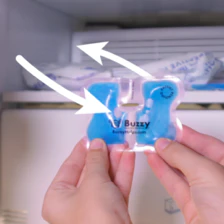
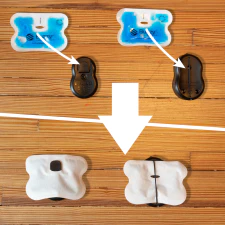
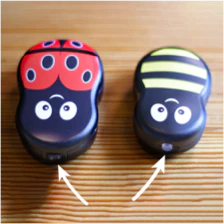
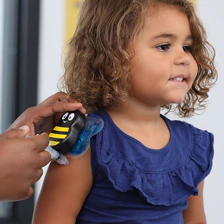
cold naturally interrupts the sharp pain feeling from needles. Studies have shown that putting an ice cube on the site before a shot can decrease the pain. Adding an element of vibration during the poke can help as well, like when a dentist wiggles your lip during novocaine. Buzzy, a combination massager with ice pack, was designed for this, but any vibrating source pressed firmly above the injection site during the shot will do.  For best results, let the child feel how the combination changes sensations beforehand by scratching the arm under the ice pack/vibration source. “See how cold this is, and see how now you can’t feel so much any more?”   Seeing for themselves and agreeing with you helps the child feel in control.  

One recent study even found a vibration source on the opposite arm from the shots along with the suggestion “This may make your arm confused about what [is] sharp and what [is] not” effective as part of a multi-sensory distraction. 

Whatever happens, praise how they did! 

Please login to be able to chat.

Privacy Policy | Copyright by ©MMJ Labs, LLC.